Who Sold Whom: Ghana's Slave History Without the Marketing
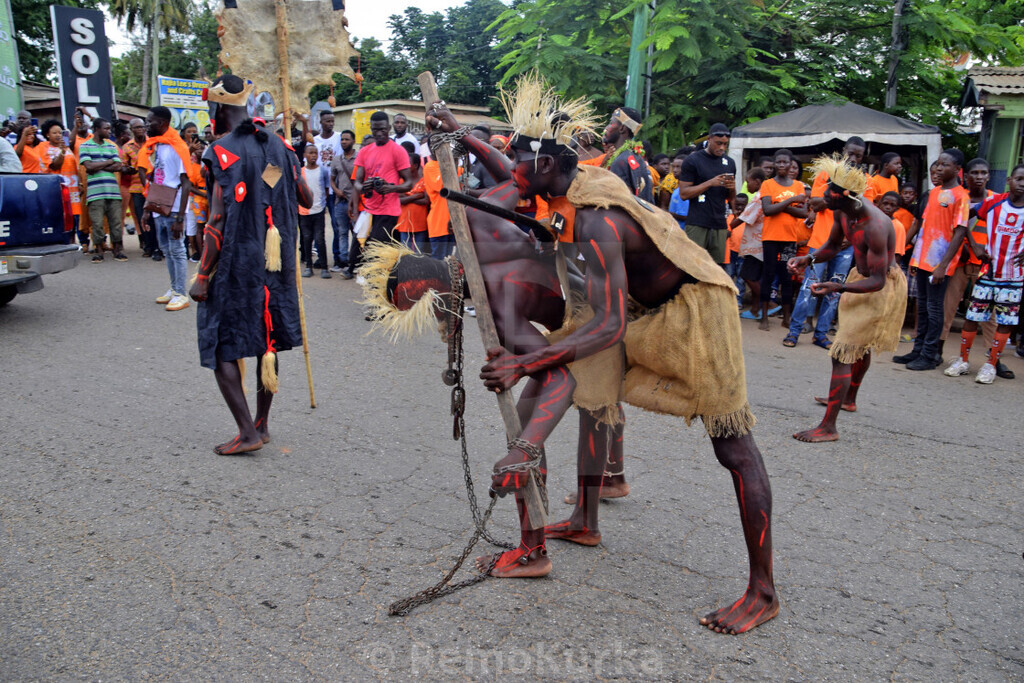
Ghana Without Filters · Diaspora · Long read
This is the part of Ghana's slave history that is not on the tour.
Where the captives actually came from. Who profited, from the northern raids to a merchant's house in Osu. Why Ghana receives the world's largest homecoming pilgrimage on a fraction of the trade. And why the descendants of the people who were taken are still the poorest citizens of the country that sells their story.
Search our Network. Start here.
Before anyone quotes me
There is a version of this argument used by people who want to end at a particular destination: Africans sold each other, therefore Europe owes nothing. That is not where this goes, and anyone quoting me in that direction is quoting me dishonestly.
African elites sold into a market that European capital created, financed, insured, armed and sustained for four hundred years. The scale was European. The industrial organisation was European. The racial chattel system was European: the invention that a person's children and grandchildren were property forever because of their colour. The demand was European, and where the demand stopped, so did the supply.
Saying African elites participated is not the same as saying they were equally responsible. Only the first of those two statements is being made on this page.
Both things are true at once, and this website has never been in the business of choosing the comfortable half.
Start with the word
Forty kilometres inland from Cape Coast there is a river called Donkor Nsuo. Every guidebook translates it as "Slave River" and moves on. Sit with the word a moment longer.
Donkor, plural nnonko, meant a slave. It also came to mean a northerner. The two meanings collapsed into one word, and stayed collapsed, and the collapse itself is the history. If the word for "slave" becomes the word for "person from the north", that tells you who was being sold, by whom and for how long, more precisely than any document.
The word is on the signboard at Assin Manso, a site visited by tens of thousands of diaspora travellers a year. Almost nobody reads it that way, and nobody at the gate explains it.
Where the captives actually came from
Not the coast. The coast is where they were sold, not where they were taken.
They were marched from the savannah: from what is now the Northern, Savannah, North East, Upper East and Upper West regions, and from beyond, out of present-day Burkina Faso and further. They were Gonja, Dagomba, Grusi, Gurma, Builsa, Sisala, Kusasi, Frafra, Mamprusi and Wala. They walked hundreds of kilometres, in chains, in the dry season, through country most visitors now fly over on the way to Mole.
They were gathered at camps like Pikworo near Paga and at markets like Salaga, the great inland trading centre of this traffic. Today Salaga has no visitor economy, no funding and no place whatsoever in the pilgrimage built on what happened there. From there they went south, through Assin Manso, to Cape Coast and Elmina, and out.
When Asante conquered Gonja and Dagomba in the 1740s, the tribute was set partly in people. That is not a controversial reading. It is in the standard histories, and it is taught at the University of Ghana.
Who sold them, and what they got for it
The Atlantic trade did not run itself. Europeans died fast in this climate and rarely went inland. The system needed African states to supply, transport, hold and broker the captives. Those states did it, and they were paid.
Asante expanded partly through war and raiding, took tribute in captives, and turned the proceeds into gold, guns and the machinery of one of West Africa's most formidable states. The Fante coastal states made their wealth as middlemen between the interior and the forts, controlling access to the beach and taking a cut of everything that crossed it. All along the coast, from Anomabo to Keta, brokers, caboceers and chiefs grew rich on commission.
That wealth built stools, dynasties, palaces and traditional authorities that still exist, still hold ceremonial power, and still sit in state at durbars, including the durbars that welcome the diaspora home.
Now the complication, because this is not tribal score-settling. The Fante were raided by Asante too. The Ga were caught up in it. Northern kingdoms ran Salaga themselves and traded in captives long before and long after any European arrived. Indigenous slavery in this territory predated the Atlantic trade and outlasted it, and that is the central finding of Ghana's own leading historian on the subject. There is no clean map of guilty tribes and innocent ones. There is a system, and there are degrees of profit from it, and the coast profited most.
The trade inside a private house: Richter House, Osu
The castles are the stone face of this history. But the trade also lived in private homes, family firms and marriages. The clearest example in Accra stands a short walk from Osu Castle (Christiansborg).
Richter House, often called Richter Fort, was built around 1807–1809 by Henrich Richter (1785–1849), a Euro-African merchant and the son of the Danish official and trader Johan Emanuel Richter. By the early nineteenth century he was one of the most powerful private traders on the Danish-controlled coast. His house was more than a residence. It was a fortified trading base, with thick walls and room for hundreds of workers, both free and enslaved.
Now look at the date. Denmark had banned its own slave trade by a decree of 1792, which took effect on 1 January 1803. Richter's compound went up after that date, beside a Danish castle whose officials were supposed to enforce the ban. Local tradition and some researchers describe an underground passage linking the house to the castle's dungeons, a way to move captives out of sight and beyond Danish oversight. Parts of it are sealed or collapsed, and it has never been fully excavated, so treat the details with care. But the principle it stands for is documented and not in doubt: the machinery of slavery extended well beyond the official forts, into the homes and enterprises of the mixed merchant families who lived beside them.
The Richters were not unique. Accra's Euro-African families, among them the Bannermans of Jamestown, whose James Bannerman later served as acting governor of the Gold Coast, were the coastal elite of the nineteenth century. They were born of European fathers and Ga or Fante mothers, educated, wealthy and politically powerful, and they lived in the trading world that the forts created. Their names are still on Accra's streets and in its old families today.
Read more on our Osu site: Richter House, Osu: a hidden stronghold of trade, power and slavery, The Two Faces of Osu and the 300+ castle slaves buried beneath the courtyard of Christiansborg.
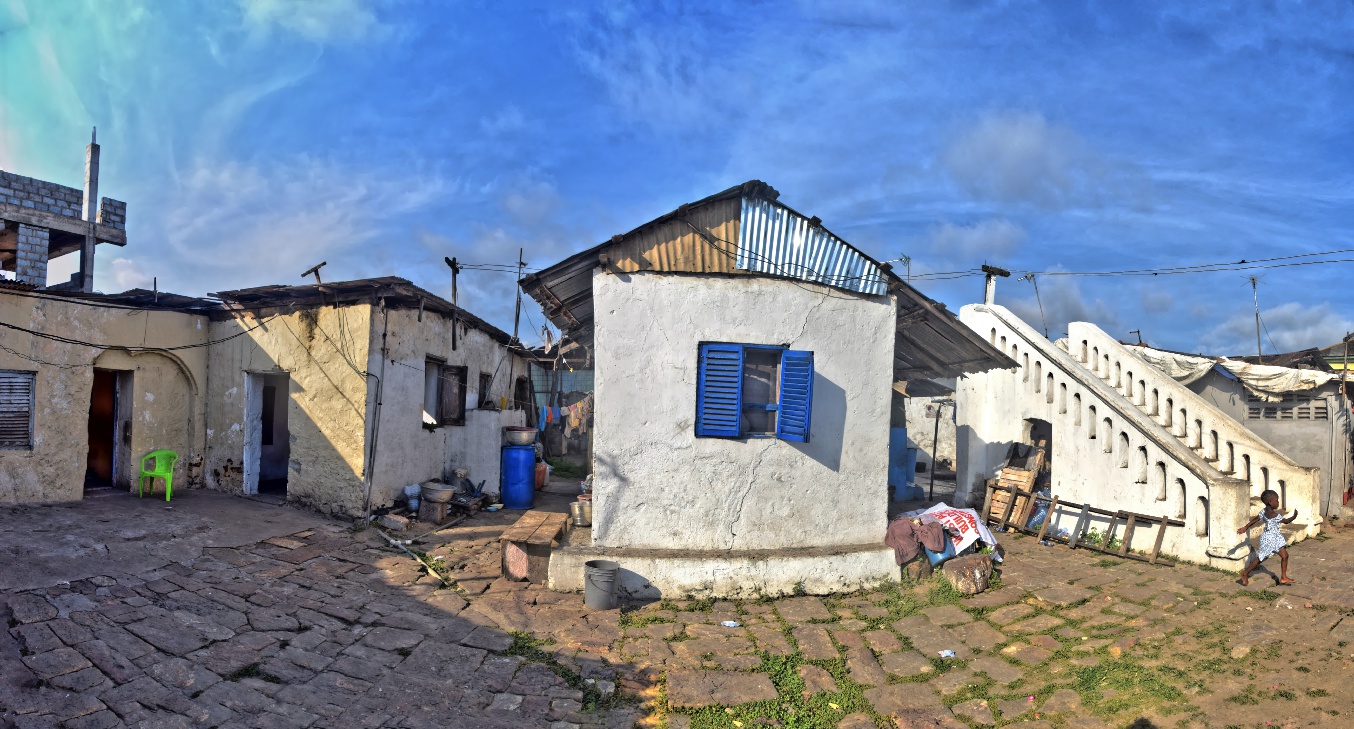
Richter House (Richter Fort) in Osu, Accra, built around 1807–1809 near Osu Castle. A private merchant compound linked to the slave trade, after Denmark's ban had taken effect. © Remo Kurka
Ghana was never the main source. Not close.
Here is the fact that reorganises everything, and it is not obscure. It sits in the standard database that every historian of the trade uses.
Of roughly 12.5 million people embarked across the whole Atlantic trade, around 5.7 million left from West Central Africa: Angola, the Congos, Gabon. That is the largest single source region by an enormous margin. The Bight of Benin, the Dahomey coast, accounts for roughly two million more. The Bight of Biafra sent vast numbers of Igbo people. Senegambia sent its own.
The Gold Coast, today's Ghana, accounts for roughly 1.2 million, about one in ten.
Be careful with that, because it cuts two ways, and the distinction matters. The people who walked through Assin Manso and out of the door at Cape Coast were overwhelmingly from the Gold Coast and its northern hinterland. Those were local doors for local captives, and nothing on this page reduces what happened in those dungeons by a single person.
But at the scale of the whole Atlantic, Ghana was a mid-sized participant in a system whose centre of gravity lay fifteen hundred miles to the south-east.
For African Americans specifically, Gold Coast ancestry is a minority ancestry. The dominant origins for arrivals in North America were West Central Africa, the Bight of Biafra and Senegambia. Most African Americans who fly to Accra to stand in a dungeon are standing in a dungeon their ancestors almost certainly never entered.
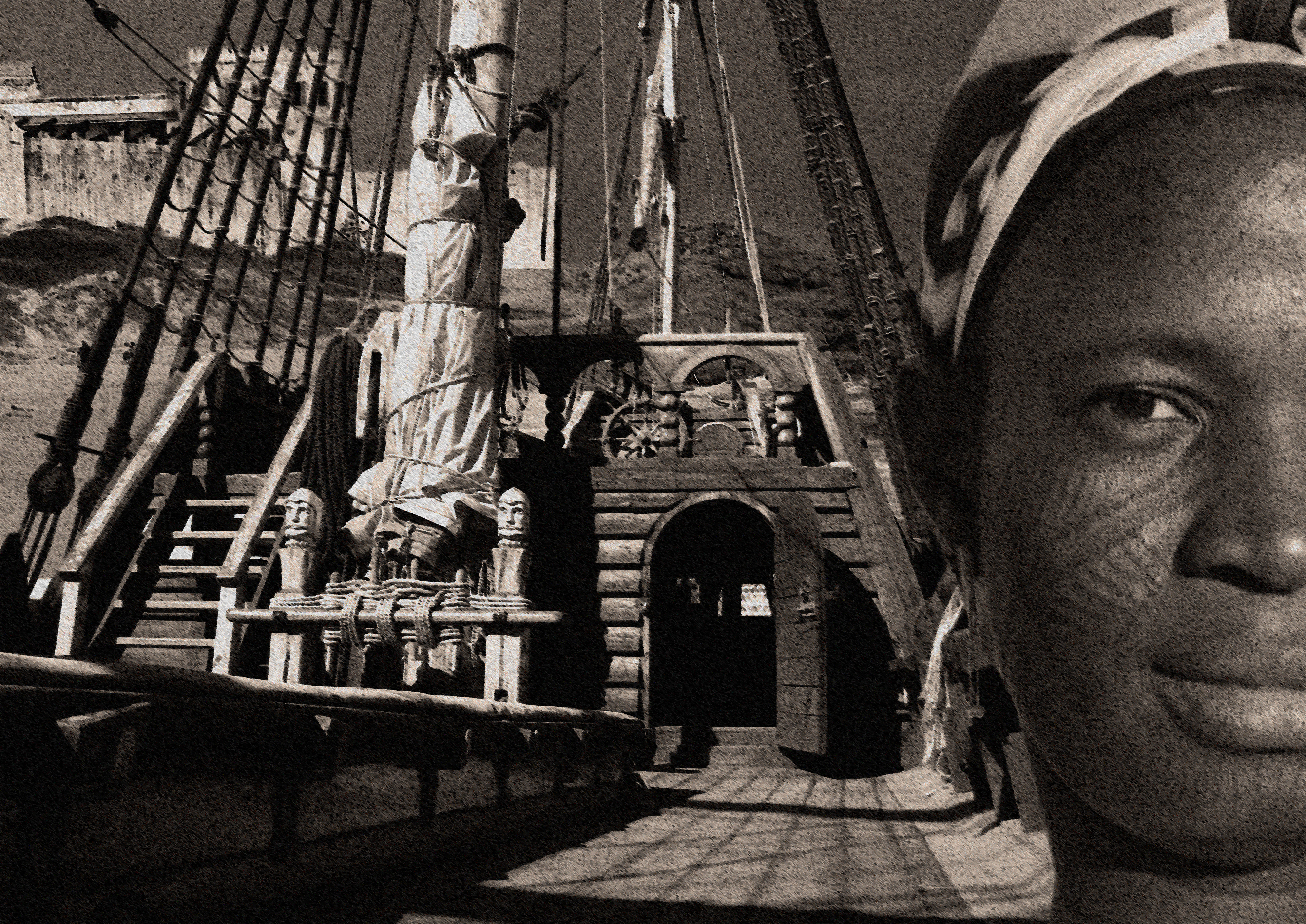
Photo composite in black and white: a slave vessel, the face of a woman, and Cape Coast Castle in the background. © Remo Kurka
Ghana won the memory, not the trade
So why here? Why does Ghana receive the largest diaspora homecoming movement on earth, while Luanda, Ouidah, Bonny and Calabar, which sent far more people, receive almost nobody? Not because Ghana lied. Because Ghana turned up.
- Nkrumah made Accra the capital of Pan-Africanism in 1957 and invited the diaspora to come and build a continent.
- W.E.B. Du Bois came, took Ghanaian citizenship, died in Accra and is buried there. That grave is a magnet no other African capital has.
- The castles survived intact, because they were built of stone by companies that intended to stay. Ouidah's embarkation point is a beach.
- English, and a stability few of its neighbours have matched, meant the diaspora could actually come.
- Ghana built the museums, ran Emancipation Day, launched PANAFEST and then the Year of Return, while other countries with far heavier involvement built nothing and said nothing.
Ghana did the memorial work. It deserves credit for that, and it is the single best thing any African state has done on this subject. But doing the memorial work is not the same as being the source, and the tourism industry has been quietly content to let visitors confuse the two for thirty years.
Ghana has already said all this. Out loud. Repeatedly.
If you think this page is a foreigner attacking Ghana, look at the record.
- 10 August 1999: Nana Boa Amponsem, the Denkyirahene and then President of the Ghana House of Chiefs, publicly and officially apologised to Africans and people of African descent for the role of pre-colonial chiefs and elders in the trade.
- 2006, Project Joseph: a national initiative inviting the diaspora back, framed explicitly as an apology for Ghana's role. It was named after the biblical Joseph, the man sold into slavery by his own family. Ghanaians chose that name.
- 2007: President John Kufuor, in London, rejected the idea that Europe bore sole responsibility, saying that "some local indigenous groups were also guilty".
- 2022: Nana Obokese Ampah I, king of Asebu, issued a public apology to the diaspora for the actions of his kingdom's rulers during the trade.
- Throughout: Professor Akosua Adoma Perbi of the University of Ghana, Ghana's permanent representative on UNESCO's Slave Route Project, has documented indigenous slavery in this country more comprehensively than anyone alive.
Note what is missing from that list: a formal apology from the Ghanaian state itself. Chiefs have apologised. A president acknowledged it abroad. A national tourism programme was named after a man sold by his brothers. But there has been no government apology, and the honest reason is that it would sit awkwardly beside a reparations argument directed at Europe.
That is a shame, because the reparations case does not need the selective version. As a Ghanaian commentator put it better than I can: an argument built on partial history is weaker than one that confronts the whole record.
The observation that explains the silence. Professor Emmanuel Akyeampong of Harvard has written that in the Americas, the descendants of the enslaved hold this history as a central part of who they are, while on the continent the preference is to end the conversation. Two peoples, one event, opposite relationships to remembering it. Everything awkward about diaspora tourism in Ghana lives in that gap.
The people who were taken have descendants too
This is the part that should be uncomfortable for everyone, including me.
The regions the captives were marched out of, the Northern, Savannah, North East, Upper East and Upper West regions, are today the poorest regions of Ghana by essentially every measure: the lowest incomes, the lowest school completion, the worst infrastructure, and the highest out-migration to the south for work.
The coast, where they were sold, has the castles, the museums, the UNESCO listings, the universities, an international airport two hours away, and an entire heritage tourism economy. Cape Coast Castle alone drew over 120,000 visitors in the last year counted.
Salaga has none of it. The market where the marches converged, the wells where captives were washed before sale, the graves: there is no visitor centre worth the name, no programme, no coach parties, no revenue. A diaspora traveller can spend two weeks in Ghana on a roots tour and never go within two hundred kilometres of where the people being commemorated were actually taken from.
So the shape of it is this: the money generated by remembering the trade flows to the descendants of the people who sold, and not to the descendants of the people who were sold. It flows exactly where it flowed in 1750, along the same road, in the same direction.
Nobody designed that. It is what happens when tourism follows tarmac and photogenic stone. But it is what is happening, and it is not mentioned in a single brochure.
What would actually change it
Not guilt, and not less pilgrimage. Ghana should absolutely keep receiving the diaspora and should be proud that it does. Four things would change it, all of them achievable.
- Tell the northern half at the coastal sites. The guides at Cape Coast and Elmina are excellent, but their script begins at the door. It should begin at Salaga. Add ten minutes and a map, and the whole story changes shape.
- Put Salaga, Pikworo and Richter House on the route. Properly funded sites in the north, linked to Assin Manso, the castles and the merchant houses of Osu as one journey, would spread the revenue to the regions that supplied the people, and make the pilgrimage complete rather than partial.
- Stop selling ancestral certainty. "Welcome home" is beautiful, and for most African American visitors it is also geographically unlikely. The honest version is more moving, not less: your ancestors probably left from further south; we kept the memory for all of you; you are welcome here.
- Say it at state level. The chiefs did it in 1999. A country that named a national programme after Joseph can finish the sentence.
I have run websites about this country for twenty-five years, and I did not write this to diminish it. I wrote it because the version currently sold to the diaspora is a marketing narrative wearing the clothes of history. The people paying for it deserve better, and so do the people in Bolgatanga, Tamale and Salaga whose ancestors were the cargo and whose grandchildren get nothing from the retelling. You can love a place and refuse to lie about it. That is the entire point of this website.
Visit the sites, and ask for the whole story. Tour the castles and Assin Manso with a local guide, and ask about the north and about Salaga. These tours are run by local operators. Entrance fees are already included in the tour price. Tips are not included, but they are always welcome.
Read further, and check me
Do not take my word for any of this. Read Ghanaian scholarship first, because Ghanaians got here long before I did.
- Akosua Adoma Perbi, A History of Indigenous Slavery in Ghana: From the 15th to the 19th Century (Sub-Saharan Publishers, Accra, 2004). The foundational work, based on the most comprehensive oral history project on slavery carried out in any single African country.
- Emmanuel Akyeampong, "History, Memory, Slave Trade and Slavery in Anlo (Ghana)", Slavery and Abolition.
- Rebecca Shumway, The Fante and the Transatlantic Slave Trade.
- Ivor Wilks on Asante state formation and the northern tribute.
- Saidiya Hartman, Lose Your Mother: an African American writer in Ghana finding that the locals saw her as a foreigner, and that the complicity went unspoken. She wrote it two decades ago, and it still stings.
- The Trans-Atlantic Slave Trade Database (slavevoyages.org), where the embarkation figures come from. Look them up yourself. It takes five minutes.
The route, in the order it happened
- Pikworo Slave Camp, Paga: where the march began for many
- Salaga Slave Market: the great inland market
- Assin Manso Ancestral Slave River: the last bath, and the sorting
- Cape Coast Castle: the dungeons, and the church built above them
- Elmina Castle: built in 1482, the oldest European building south of the Sahara
- Osu Castle (Christiansborg) and Richter's Fort: the Danish coast and the private trade
- Britain and the West African trade: the company, the ledgers, the profit
- The Forgotten Giants of the Atlantic Slave Trade: the states and firms that ran it
- PANAFEST: the pilgrimage as it exists now
More from Ghana Without Filters
- The Biggest Lies Influencers Tell About Ghana: the companion piece
- Why the African Diaspora Should Visit Ghana in 2027: Ghana at 70
- The Emotional Reality of Returning Home
- A Few Words Go a Long Way: The Languages You Will Hear in Ghana
- Buying Property in Ghana: What Diaspora Buyers Are Not Told
- The Biggest Mistakes Returnees Make When Moving to Ghana
- Why Many Returnees Fail, and How to Avoid It
- How to Prepare for Moving to Ghana: A Real Checklist
- The Hidden Costs of Living in Ghana
- Ghana Road Deaths: Eleven Billion Cedis Idle
- Ghana Government: Ghana's Digital Identity Is Being Hijacked – Where Are the Authorities?
- The Sad Reality of VisitGhana.com
- Ministry of Tourism: Thank You for Bringing Ghana Travel Back Online
- The Ghana Guide That Sends You to Singapore: How to Spot an AI-Written Travel Book
- Why You Don't Need Another Ghana Travel Book
- Your Next Trip to Ghana: €53.90 for 13 Days? Seriously?
On Ghana-Net.com
Sources: Embarkation figures from the Trans-Atlantic Slave Trade Database. Apology dates from contemporary Ghanaian press reporting and published records. Visitor numbers from the Ghana Tourism Authority. Richter House from the author's own research on osucastle.ghana-net.com, drawing on The Nana Project, the Journal of Modern Slavery, The World (PRX) and Quartz Africa. If you find an error in this piece, write to us and we will correct it in public. That is how this site has worked since December 2000.
Written by Remo Kurka, Ghana-Net.com · First published 14 August 2026 · Updated and fact-checked: 5 November 2026