The Ghana Guide That Sends You to Singapore: How to Spot an AI-Written Travel Book
Ghana Without Filters · Before you buy
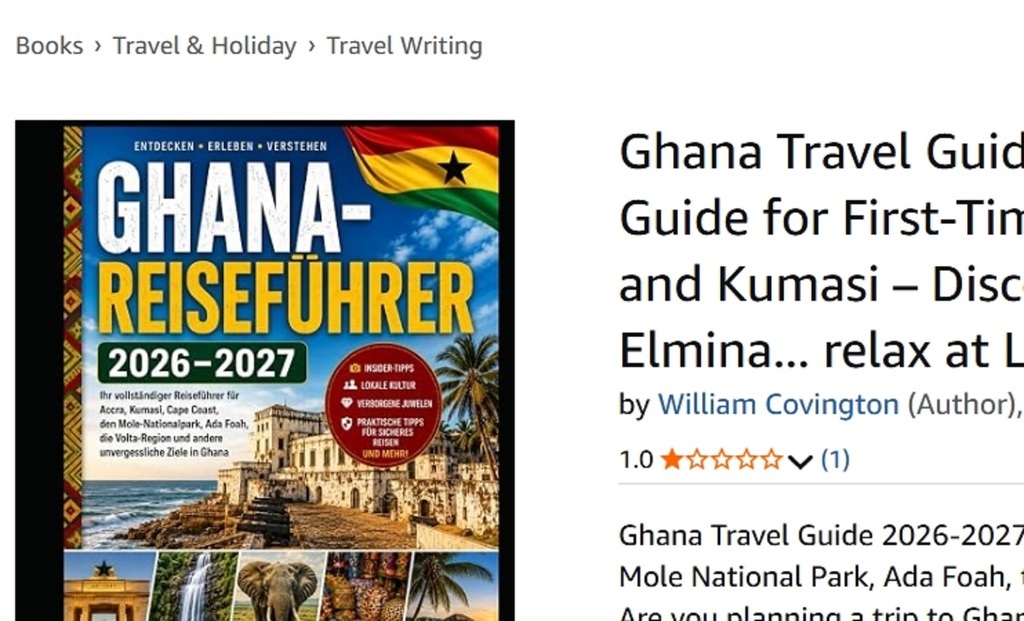
One morning in October, over coffee, I found a brand-new Ghana travel guide for 2026–2027: 119 pages, a glossy cover, a promise of "insider tips" and "hidden gems".
Its subtitle invites you to relax at Labadi Beach. Its one and only review gives it one star and says the book talks about restaurants in Singapore. I laughed. Then I clicked on the author's name, and stopped laughing.
Search our Network. Start here.
What the cover promises
The title alone is a small masterpiece of search-engine poetry: Ghana Travel Guide 2026–2027: The Ultimate Guide for First-Time Visitors to Accra, Cape Coast and Kumasi – Discover Cape Coast Castle and Elmina… relax at Labadi Beach. There is a hardcover, a paperback, an author's name and a translator's name. The listing does not say who the author is, or where he has travelled in Ghana.
The blurb is the kind you have read a hundred times: "Are you planning a trip to Ghana and looking for a reliable, practical and easy-to-understand travel guide?" It promises to accompany you "step by step through every phase of your journey". It could describe any country on earth.
Relax at Labadi Beach. Really?
Anyone who has followed Accra's news in 2026 knows what happened at Labadi: demolitions along the beachfront that changed the place most visitors knew. A guide written this year by someone who had been there, or had even read a newspaper, would at least warn you. This one puts Labadi in its title as a place to relax.
For what Labadi and Accra's beaches actually look like now, read our honest guide to Greater Accra's beaches and the December 2026 guide.
What the only reviewer says
A one-star review from Germany, dated 12 October 2026 and headed "Worst travel guide", says the book was written with AI and never checked. According to the reviewer, the errors start in the table of contents, the book talks about restaurants in Singapore, and it contains typical traces of AI use such as leftover square brackets. "So not recommended."
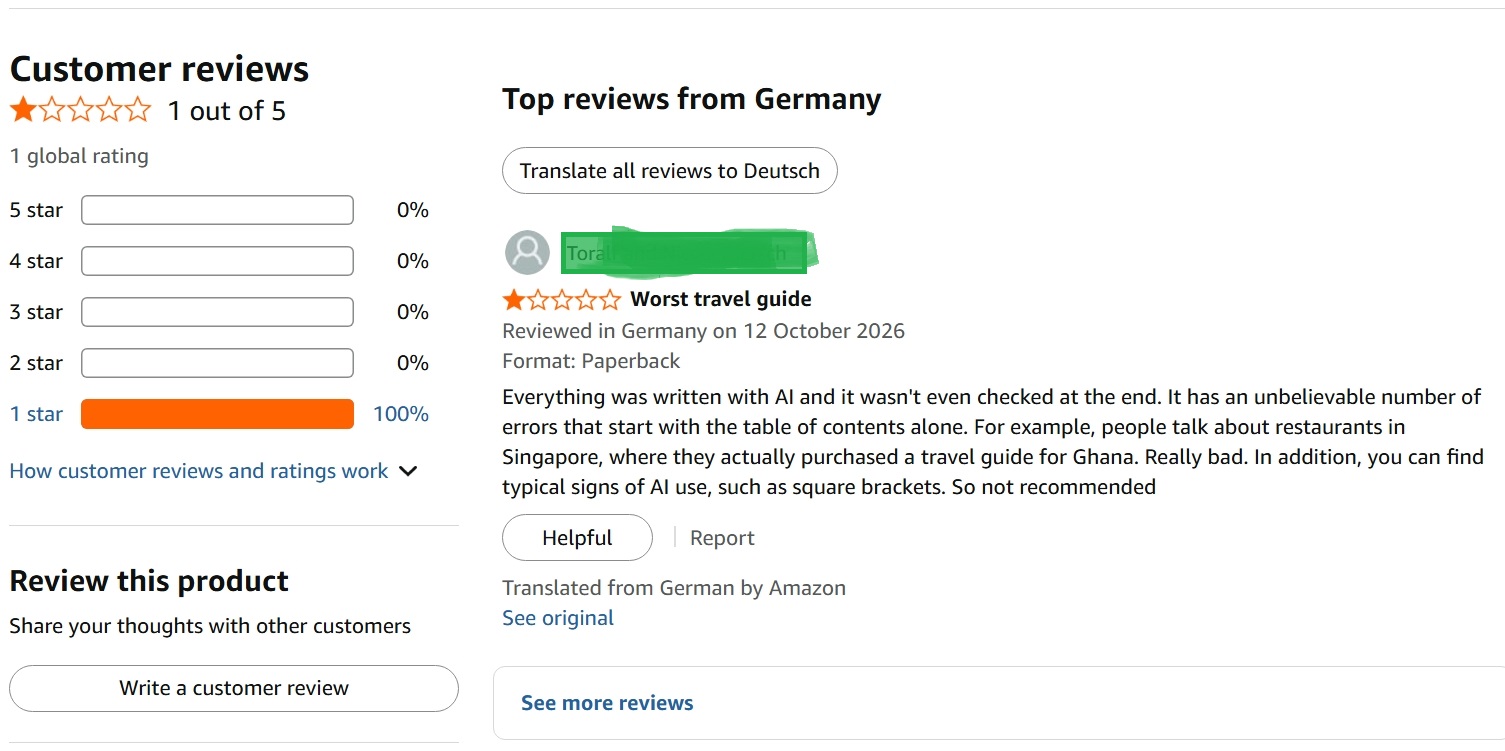
Screenshot: Amazon.de, 16 October 2026. Reviewer's name removed.
Then I clicked on the author
The author's page on Amazon has a name and a grey placeholder silhouette. That is all. There is no biography, no photograph and no word about who he is, where he has travelled, or why anyone should trust him on any country at all.
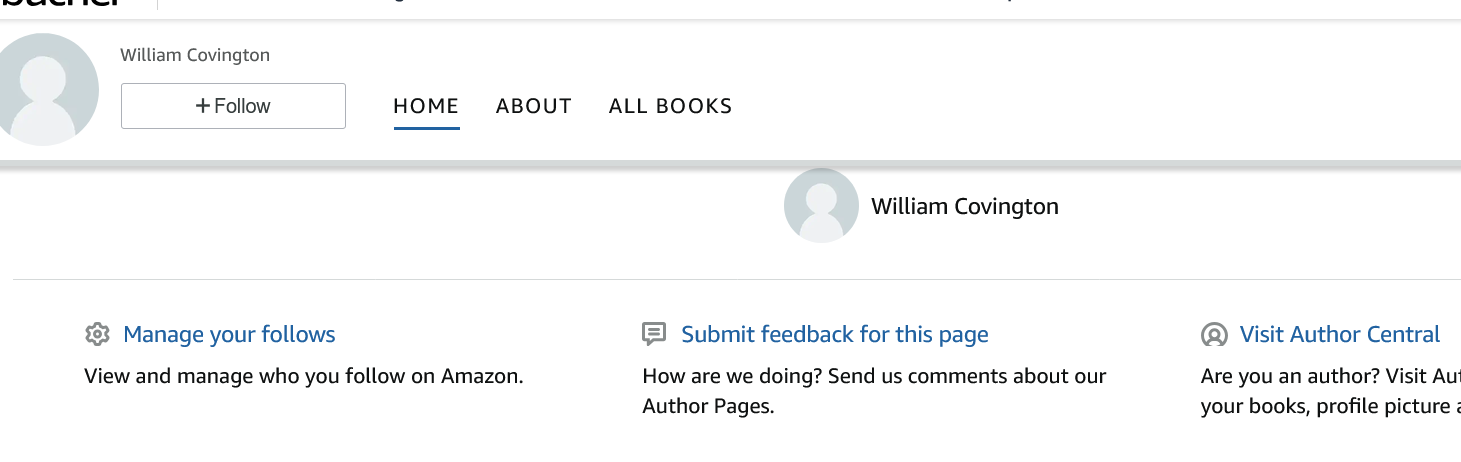
The author page as shown on Amazon.de on 16 October 2026: no biography. Screenshot: Remo Kurka.
Below it, under "All Books", the English titles alone add up to eight travel guides. Almost all are for "2026–2027", all have the same glossy cover style, and all are hardcovers at around 22 to 26 euros:
- Glacier National Park, USA
- Corfu, Greece
- The Louvre Museum, Paris
- Bhutan
- Vatican City
- Ghana
- Mozambique
- Umbria, Italy
The same books then appear again in German and other languages, which is why the author's page shows far more than eight editions. And one title, for Bhutan, promises to be "The Most Complete First space Timer's…" guide. "First space Timer". Nobody, it seems, ever read the cover.
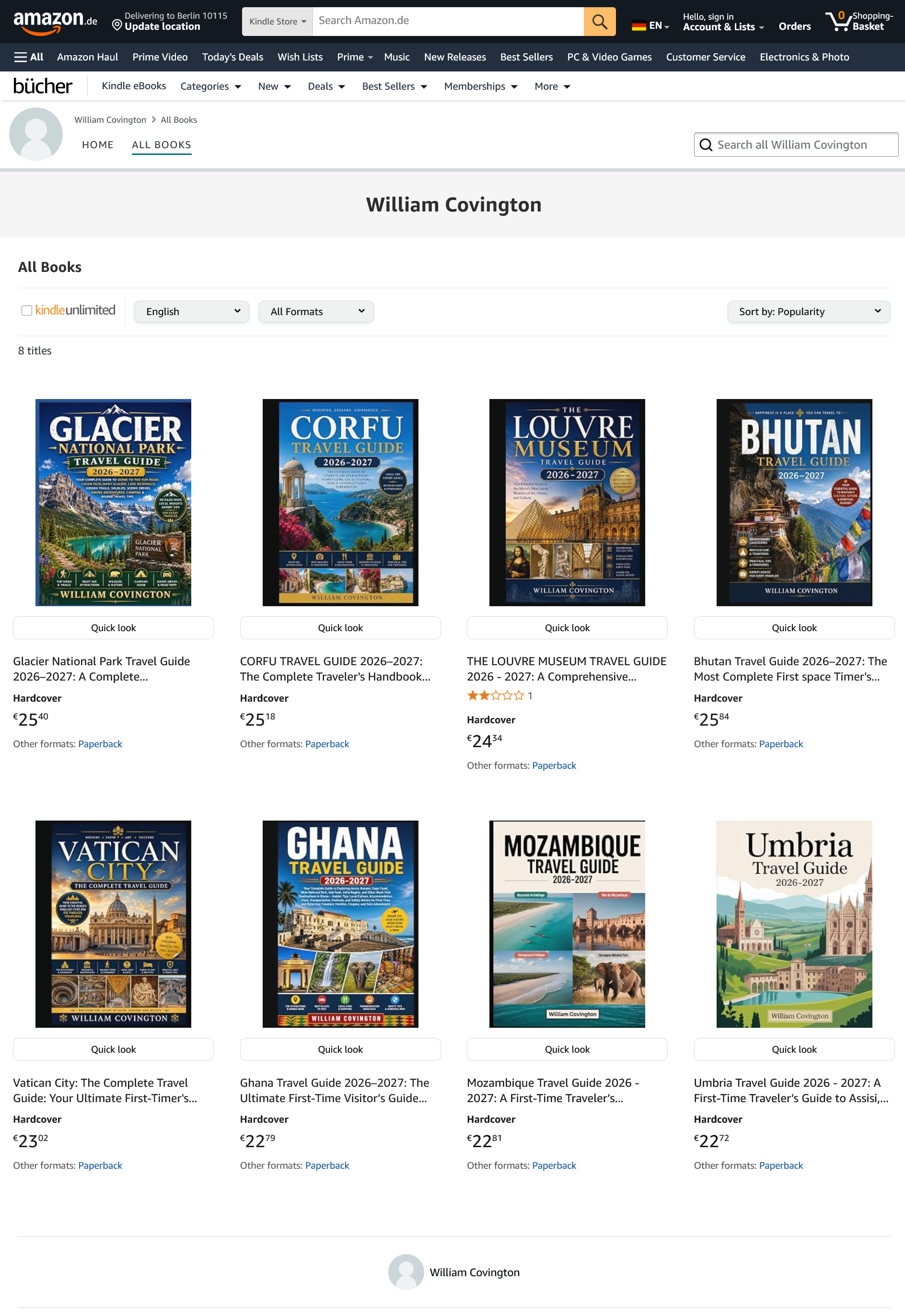
Eight destinations on three continents, one author, one cover style. Amazon.de, 16 October 2026. Screenshot: Remo Kurka.
Ask yourself one question. Could one person gain real first-hand knowledge of Accra's trotro stations, the Vatican's opening hours, Bhutan's visa rules, Corfu's beaches, Mozambique's islands, Umbria's hill towns and the trails of Montana, and publish all of it for the same two years? A guidebook from a real publisher takes many months, often years, of writing, editing and fact-checking for a single country.
How Amazon lets it through
Amazon does not ban books written by artificial intelligence. Since September 2023, self-publishers on its Kindle platform have had to tell Amazon when a book's text, images or translations were generated by AI. But Amazon has never made clear how it checks those answers, and as far as is publicly known, buyers looking at the product page are not shown them.
Amazon's main brake on the flood of such books is a limit of three new titles per day per account. Three a day is more than a thousand books a year.
In my opinion, this is not publishing. It is a business model that lives on the trust of travellers who cannot yet know what they are buying, and on platforms that profit from every sale whether the book is true or not.
Why this matters more for Ghana than for Paris
A bad guide to Paris costs you a disappointing dinner. A bad guide to Ghana can cost you far more. It can send you to a beach with deadly rip currents, to a museum that has been closed for months, to a fort you cannot enter, or through the wrong visa process. Since 25 May 2026 every visitor must apply online before flying, and a book printed earlier simply gets it wrong. Our ETA and e-Visa page has the current rules.
It can also leave you with prices from five years ago in a country where the cedi has moved dramatically. And for many diaspora visitors this is not a holiday. It is a journey they have saved and dreamed of for years. For them, read Why the African Diaspora Should Visit Ghana in 2027.
How to spot a machine-made travel book
- The subtitle is a list of keywords. Every famous name is crammed in with ellipses and commas: Accra, Cape Coast, Kumasi, Elmina, Labadi.
- "2026–2027" on a book with no visible update. A year on the cover is free. Checking every fact is not.
- No author you can find. There is no biography, no photo from the road, no personal story and no explanation of when the author was last in the country.
- Many countries, one author, the same years. Click the author's name. If one person has "written" guides to Ghana, Bhutan, the Vatican and a US national park, all for 2026–2027, you have your answer.
- The same title, again and again. "Ultimate Guide", "Comprehensive", "Complete Handbook", with only the destination changed.
- The same cover, again and again. One design template, a new photograph, a new country name.
- A generic blurb. "Hidden gems", "insider tips", "unforgettable experiences", "step by step", and nothing specific.
- Leftover template text and typos. Square brackets, placeholders, sentences that stop mid-air, or "First space Timer" on the cover.
- Wrong places. Restaurants in another country, hotels that have closed, places that no longer exist.
- Read the sample. Amazon's "Read sample" button is your best friend. Two pages will usually tell you whether anyone has ever been there.
A confession, and the real difference
I use digital tools too. Every serious publisher does now. The difference is not the tool. It is whether someone who has actually been there checks every sentence, takes the photographs, and corrects mistakes when readers point them out.
Ghana-Net.com has been online since December 2000. It covers one country, and the neighbours that share its history, not the whole world. The photographs on our pages are my own, taken over more than twenty-five years in Ghana. When a site closes, we say so. When we get something wrong, we fix it and say that too. And everything is free to read, with no 119-page paperback required. Why I chose a living website over a book is explained in Why You Don't Need Another Ghana Travel Book.
Start here instead
- The Complete Guide to Ghana: visas, money, transport and what nobody tells you
- Accra, Cape Coast and Kumasi: the three cities the guide's title promises, honestly reviewed
- Cape Coast Castle and Elmina Castle: the two castles on the book's cover, on their own dedicated sites
- Ghana ETA and e-Visa: the 2026 rules, kept up to date
- The real cost of travelling in Ghana
- The Biggest Lies Influencers Tell About Ghana
Better than any book: a guide who lives there. These tours are run by local operators who know the places first-hand. Entrance fees are already included in the tour price. Tips are not included, but they are always welcome.
More from Ghana Without Filters
- Why You Don't Need Another Ghana Travel Book
- The Sad Reality of VisitGhana.com
- Ministry of Tourism: Thank You for Bringing Ghana Travel Back Online
- Ghana Government: Ghana's Digital Identity Is Being Hijacked – Where Are the Authorities?
- Your Next Trip to Ghana: $53.90 for 13 Days – Seriously?
- The Biggest Lies Influencers Tell About Ghana
- Why the African Diaspora Should Visit Ghana in 2027: Ghana at 70
- Who Sold Whom? Ghana's Slave History Without the Marketing
- A Few Words Go a Long Way: The Languages You Will Hear in Ghana
- Ghana Road Deaths: Eleven Billion Cedis Idle
- How to Prepare for Moving to Ghana: A Real Checklist
- The Hidden Costs of Living in Ghana
- The Biggest Mistakes Returnees Make When Moving to Ghana
- Why Many Returnees Fail, and How to Avoid It
- The Emotional Reality of Returning Home
- Buying Property in Ghana: What Diaspora Buyers Are Not Told
On Ghana-Net.com
Sources: Book title, listing, author page and review as shown on Amazon.de on 16 October 2026. The review is quoted in Amazon's own English translation, with the reviewer's name removed. Amazon's AI disclosure rules and the three-titles-a-day limit as reported by the Authors Guild, the Alliance of Independent Authors and The Guardian (2023). We have not bought the book, and judge it only by its listing, its sample, its author page and its published review.
Written by Remo Kurka, Ghana-Net.com · Amazon listing checked: 16 October 2026 · Updated and fact-checked: 5 November 2026