Eleven Billion Cedis Sits Idle. The Road Still Kills
Ghana Without Filters · Eleven billion cedis sits in a bank account. The road still kills.
A warning for Ghanaians abroad and anyone planning to travel home. This is not the version the Ministry of Tourism publishes. It is the version with the numbers in it.
You know the drive: Accra to Kumasi, four hours on a good day, seven on a bad one. Somewhere past Nsawam the dual carriageway runs out and you are on a single lane, with articulated trucks coming the other way at speed. Somewhere near Suhum the traffic slows for no reason, and then you see why, and nobody in the car says anything for the next twenty minutes.
Most of us have decided not to think about it. This article is an argument for thinking about it, because the numbers are worse than the feeling, and because the money to fix it exists and is not being spent on fixing it.
Search our Network. Start here.
Update · 5 November 2026
The death toll keeps rising. A contractor has been promised "within four weeks" since mid-September. Construction has moved to January 2027.
The road
- On 8 October 2026 the police Motor Traffic and Transport Department reported 2,151 deaths and 12,230 injuries in 10,157 crashes between January and September 2026. That is about eight people killed on Ghana's roads every day.
- The National Road Safety Authority's certified figure for January to June 2026 was 1,492 deaths, around 250 a month.
- For the full year 2025 the NRSA recorded 2,949 deaths, up 18.2 per cent on 2024, and it names Ashanti, Eastern and Greater Accra as the critical death zones. December has historically been the worst month. If you are coming home for Christmas, read Part Five below twice.
The expressway
- The invitation for contractors to pre-qualify was published on 11–12 September 2026. Government said a contractor would be selected within four weeks, and the President promised to cut the sod before Christmas.
- The managing director of Accra-Kumasi Expressway Ltd, Francis Ahlidza, has since said construction is expected to begin in January 2027 and finish in December 2028, through a two-stage international competitive procurement.
- As of 5 November 2026 we have found no public announcement naming the main contractor, and still no published total project cost.
- Even the length is not consistent. The concession and earlier statements give 198.7 kilometres. The September handover and several later official statements give 175.6 kilometres. That is a difference of 23 kilometres on a road said to cost about US$4 billion, and it deserves a published explanation.
Flying is still the safer choice, but build in slack
On 26 October 2026 both Africa World Airlines and PassionAir cancelled their Kumasi–Accra flights, leaving passengers stranded at Prempeh I International Airport. Domestic flights are far safer than the road, but they are not a train timetable. Never book the last flight of the day before an international connection.
Update · 18 September 2026
The account is filling. The road is not being built. And on 14 September the country was shown half the money as though it were all of it.
The figures since this article was first published
- 16 July 2026: the Controller and Accountant-General confirms that GH¢11 billion, roughly US$1 billion, has been moved out of the Consolidated Fund into a dedicated Bank of Ghana account and has not been paid to any contractor. That is the figure in the headline.
- 22 July 2026: Finance Minister Dr Cassiel Ato Forson tells Parliament that US$1.7 billion is now in the account, ring-fenced, and usable only once the main construction contract is awarded.
- 14 September 2026: at the handover of the cleared right-of-way at Kwaso near Ejisu, President Mahama announces US$2 billion sitting in a special account at the Bank of Ghana, adding that this is taxpayers' money and that nothing has been borrowed.
- By 31 December 2026: Dr Forson says the entire amount required will be available, and that not a single pesewa will be borrowed.
Why that announcement matters
Read against the cost recorded in this article, the sequence is not a contradiction. It is a schedule. The Finance Minister himself costed the expressway at close to US$4 billion. So the account went from about one billion in July to two billion in September, with the rest promised by the end of the year.
Which means the two billion announced on 14 September was roughly half the money for a road that costs four. It was presented as though the funding question had been settled: the money is ready, it is at the Bank of Ghana, money will not be the problem. Half is not ready. Half is half.
Nothing else has moved. There is still no published total project cost from the Ministry, no named main contractor, no published procurement terms and no construction start date. The expressway has been made the first case for Ghana's new Value for Money Office, an office that cannot measure value against a price the public has never been shown. The concession company still selects its own contractors, outside the Ministry's normal procurement chain. And the road will still be tolled for fifty years to repay money that came from Ghanaian oil and mineral revenue in the first place.
What has not changed at all
The arrears are still there: roughly GH¢40 billion owed to road contractors, unpaid certificates going back to 2018, and more than a thousand stalled projects. The last 94 kilometres of the existing Accra–Kumasi road remain unfinished, and the Minority in Parliament has asked government to spend US$300 million of the expressway money on finishing the road people actually drive on.
The corridor kept killing. On 13 August 2026 twelve people died and thirteen were injured on the same highway when two trucks, two minibuses, two cars and a tricycle collided. As with the Birimso Bridge crash of 3 August described below, no reconciled official death toll was published.
One more detail from the September ceremony belongs in this record. The President directed that the 48 Engineer Regiment of the Ghana Armed Forces be engaged as a major subcontractor to the main contractor. It is the same unit that cleared the 175.6-kilometre right-of-way in 19 weeks. Competitive pre-qualification was promised for this project. A subcontractor named by presidential directive is not competitive procurement, and neither the scope nor the price of that role has been published.
The full breakdown of the September figures is in Two Billion, One Road, and Five Questions Nobody Has Answered, and the farmers' side of the corridor is in Two Billion in the Bank: Where Is the Farmers' Compensation?
Part One: What the road actually does
Between January and April 2026, four months, Ghana recorded 4,899 road crashes. They killed 1,009 people and injured 5,982. Crashes rose 2.5 per cent on the same period the previous year, and injuries rose seven per cent.
Now the part that should hold your attention. Of those 1,009 deaths, the Ashanti Region recorded 263, the Eastern Region 218 and Greater Accra 144. Ashanti and Eastern are the two regions the Accra–Kumasi highway runs through. Between them that is 481 deaths in four months: forty-eight per cent of every road death in Ghana, concentrated along one corridor.
The World Health Organization puts Ghana's road fatality rate at close to 26 per 100,000 people. The African regional average is 19, and the global average is 15.
Say it plainly. If you are flying in from London, Hamburg, Toronto or New York, the road is the most dangerous thing you will do in Ghana. Not crime, not the water, not mosquitoes. The road between the airport and your family. Everything else you were warned about is statistical noise beside it.
The 3 August crash, and why nobody can tell you the death toll
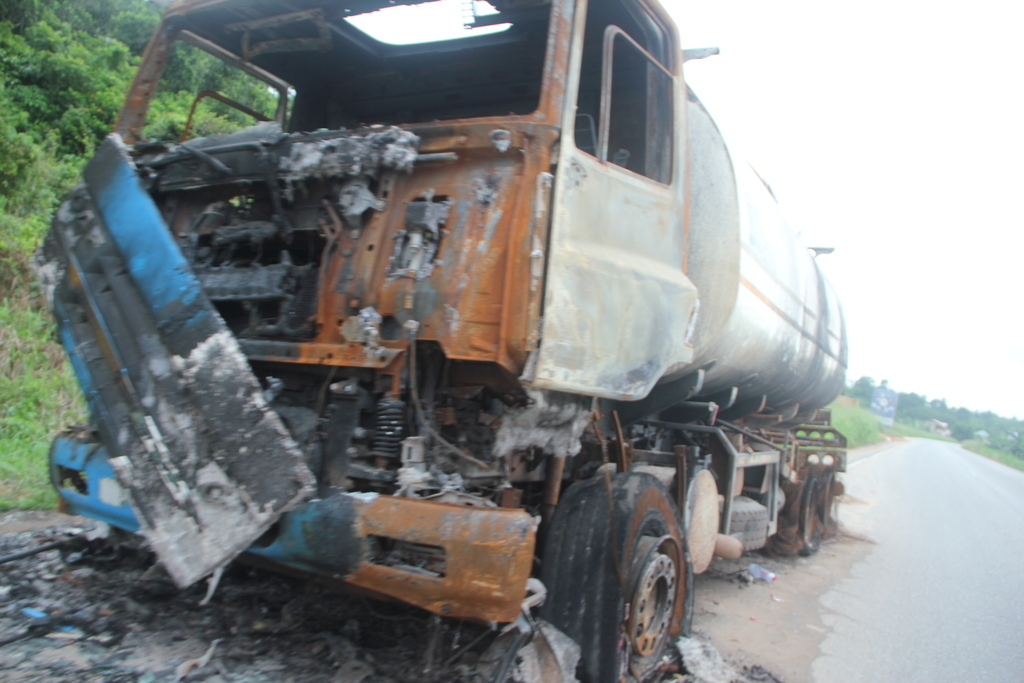
On Monday 3 August 2026 an Intercity STC bus running from Accra to Kumasi was caught in a pile-up at Birimso Bridge near Bonsu Junction on the N6, with a loaded articulated truck and a saloon car. All three vehicles burned out completely.
The Ghana Police Service recorded 12 dead and 44 injured. The Ghana National Fire Service confirmed two deaths. The bus driver, filmed with blood on his uniform and a towel held to his ear, said there had been about 31 people aboard and roughly ten got out.
Intercity STC then published a notice headed with a flat denial that anyone had died, calling the driver's account false and stating that all passengers and crew survived. Its Deputy Managing Director said the driver had described only what he saw in the first moments, and that the dead were in the private car and the tanker. How many, he could not say.
No reconciled figure has been published for a crash on Ghana's most important road. A country that cannot count its dead on a named bridge cannot tell you whether any road policy is working. Keep that in mind for everything that follows.
Part Two: The money
Here is where the story stops being about driving and starts being about something else.
The government is building a new Accra–Kumasi Expressway: six lanes, access-controlled, with eight interchanges, on a new alignment, cutting about fifty kilometres and bringing the journey down to around two hours. Parliament approved the concession in December 2025. It is a good idea. Now the numbers.
It costs four billion dollars. In mid-2026, one billion existed.
Finance Minister Cassiel Ato Forson told a business forum that government had secured US$1 billion of the nearly US$4 billion required: the first US$500 million from uncapped oil revenues channelled directly into the project, the other US$500 million from mineral royalties. US$4 billion across 198.7 kilometres is roughly US$20 million per kilometre.
And the money that does exist is doing nothing
On 16 July 2026 the Controller and Accountant-General's Department issued a statement to kill a rumour that GH¢11 billion had been spent on the project. Its denial was more alarming than the rumour. CAGD confirmed that, after Parliament approved the concession, proceeds from the Annual Budget Funding Amount and mineral royalties were transferred out of the Consolidated Fund into a dedicated Bank of Ghana account. It added that these funds had not been paid to any contractor or spent on construction, but remained in that account pending project execution.
GH¢11 billion, about one billion dollars of Ghana's oil and mineral money, taken out of the national budget and sitting in a bank account, building nothing.
Now put the two facts together
Ghana's road sector carries roughly GH¢40 billion in unpaid contractor arrears: GH¢21 billion on the Government of Ghana account, over GH¢8 billion under the Road Fund, plus Cocoa Roads. Unpaid certificates go back to 2018. More than 1,000 road projects stalled nationwide because contractors were not paid and walked off site. The Finance Minister put total supplier and contractor arrears across all sectors at GH¢67.5 billion.
So contractors are off the roads that are killing people, because there is no money. And eleven billion cedis is parked in a Bank of Ghana account, waiting for a road that had not yet been designed.
You will pay for it twice
The expressway is being built by Accra-Kumasi Expressway Ltd, a private limited company set up as a special purpose vehicle by the Ghana Infrastructure Investment Fund. It is classified as a state-owned enterprise, wholly funded with government money, and holds a fifty-year concession.
It will be tolled. The Roads Minister has been straightforward about this: government will have to repay the money, it is the people's money, and it will be recovered through tolls. The company's own MD calls it a commercial asset. Your taxes, your oil revenue and your mineral royalties build the road. Then you pay a toll to use it, for fifty years, to repay money you already provided.
And note what else the concession says. The concessionaire is responsible for feasibility studies, selection of contractors and award of contracts for construction, and supervision of the works. A company created by the state awards its own construction contracts, outside the Ministry's normal procurement chain.
Part Three: How Ghana's road contracts are actually awarded
In March 2026 The Fourth Estate, the investigative unit of the Media Foundation for West Africa, published an analysis of data it obtained from the Ministry of Roads and Highways. Of 107 road contracts awarded under the Big Push programme, the same programme funding the expressway, it found 81 sole-sourced, 26 by restricted tendering, and none awarded through competitive tendering. It reported 81 sole-sourced contracts in seven months, worth over GH¢73 billion.
It also found that Build Managers, awarded the contract to upgrade the nine-kilometre Apegusu–Mpakadan feeder road for over GH¢146 million, listed one employee on its SSNIT clearance certificate. Sanam Ghana Limited, holding two road contracts, listed four. That is GH¢146 million for nine kilometres of feeder road, and one employee on the social security filing.
When the Roads Minister addressed Parliament on the findings, he accused The Fourth Estate of fabricating the information.
Then came the government's own investigation, and the arithmetic trick
President Mahama ordered a probe. A 72-page report was produced by the Senior Presidential Advisor on Governmental Affairs: the Presidency investigating the Presidency.
Its headline finding, announced by Communications Minister Felix Kwakye Ofosu, was that only 4.58 per cent of the 1,441 road contracts awarded since January 2025 involved single sourcing, while 1,301 contracts, or 90.28 per cent, went through open competitive tendering. That sounds like an acquittal. Look closer.
Of those 1,441 contracts, only 140 are Big Push. The other 1,301 include 896 Department of Feeder Roads projects, which are small local jobs. And of the 140 Big Push contracts, 66 were single-sourced and 51 went through restricted tendering. That is 117 of 140, or 83.6 per cent, not competitively tendered. The government's own report concedes that 47.14 per cent of Big Push contracts were sole-sourced, justified by what it called urgent national considerations.
The trick is the denominator. They counted contracts, not cedis. Big Push is where the money is. The Ghana Institution of Engineers puts the programme at GH¢110 billion, with about GH¢85 billion already committed. Dilute 140 enormous contracts into 1,441 by adding 896 feeder roads, and sole-sourcing looks like a rounding error. Count by value and the number inverts.
This is not an opposition talking point. In April 2026 the Ghana Institution of Engineers, the professional body of the people who build these roads, petitioned the Auditor-General for a credible independent audit of the Big Push programme. They went over the government's head because the government had investigated itself.
Part Four: Who actually abandoned what
You will hear that the NDC abandoned the NPP's dualisation of the Accra–Kumasi road. You will hear the NDC say the NPP's contractors walked off before the 2024 election. Both camps are shouting and both are partly right, which is how nothing gets fixed.
What is documented: unpaid certificates going back to 2018, under the previous administration, and contractors halting work over money. Then in July 2025, under this administration, the Minority Leader complained in Parliament that contractors had abandoned sites over non-payment, naming the Kasoa–Winneba road. Then government paid, by its own account, nearly GH¢30 billion in arrears on inherited projects.
On the corridor itself, former Roads Minister Francis Asenso-Boakye says over 100 kilometres of the 240-kilometre route are dualised, 46 kilometres are under construction at 58 to 100 per cent progress, and only 94 kilometres remain. He calls switching to a new expressway wasteful governance driven by political optics. Roads Minister Governs Kwame Agbodza insists both projects are priorities, and that the bypasses at Osino, Anyinam and Konongo continue towards completion in 2027.
Strip away the party colours and this is what is left: the last 94 kilometres of the existing road are the cheapest lives Ghana could buy, and neither administration finished them. The four bypasses already under way, 45 kilometres in all, were awarded at GH¢1.9 billion, about GH¢42 million per kilometre. The expressway runs at roughly five times that rate per kilometre. Nobody is cutting a sod for the 94 kilometres. There is no ribbon in it. We keep a running record of such promises in Commissioned, Not Completed.
Part Five: What you should actually do
Now the practical part, because information without action is just anxiety.
Fly. Seriously, fly.
Ghana has a working domestic aviation network, and most diaspora travellers ignore it out of habit.
- Africa World Airlines flies Embraer jets from Accra to Kumasi, Takoradi and Tamale.
- PassionAir flies Bombardier Dash 8 Q400 turboprops from Accra to Kumasi, Takoradi, Tamale and, on fewer days, Wa and other regional towns, with several daily departures to Kumasi.
Both sell tickets online. The flight to Kumasi takes under an hour, against four to seven hours on the road. Fares vary widely by season, route and fare class, so check current prices directly rather than trusting any figure in an article. For routes, airlines and airports, see ghanaflights.info and our page on flights to and from Ghana.
Weigh that honestly against the alternative: a tank of fuel, a day of your life, and the single highest-risk activity available to you in Ghana. But build in slack. Flights are sometimes delayed or cancelled, and the Harmattan haze can stop landings. Never book the last domestic flight of the day before an international connection out of Accra International Airport.
And notice who else is flying
Watch the domestic terminal at Accra International Airport on a weekday morning, and watch who is boarding. The people who set road policy do not, as a rule, spend seven hours in a shared vehicle on the N6. They fly, or they travel in convoy: hard-suspension four-wheel drives, hazard lights, sometimes an escort, with other traffic expected to give way. Anyone who has driven that road has been pushed onto the shoulder by one.
This is not a conspiracy. It is simply worth understanding as a matter of incentives. The decision-makers do not personally experience the road they are deciding about. The 481 people who died in Ashanti and Eastern in four months were not in convoys.
If you must drive or take a coach
- Never travel these roads after dark. Look at the times: the Komenda crash on 12 January at 7:25 pm, the Eduadjei crash on 5 March at 7:15 pm, the Dompoase crash on 31 July at 6:55 pm. Unlit carriageways, unlit broken-down trucks on the shoulder, drivers at the end of long shifts. If you are running late, stop and go in the morning.
- Understand the killing pattern. Read the crash reports and the same sequence repeats: a vehicle overtaking on a single carriageway, an oncoming vehicle with nowhere to go, and closing speeds no vehicle survives. If you are driving, decide in advance that you will not overtake. You will arrive twenty minutes later.
- Sit away from the front of the coach. In head-on collisions the front rows take the impact.
- Wear your seatbelt, including in the back. Especially in the back.
- Speak up. If the driver is overtaking blind on a bend, say so. Ghanaian passengers do this routinely, and the police and NRSA have publicly asked them to.
- Know that emergency response is thin. After the 2016 Kintampo disaster, in which 71 people died according to the medical director at Kintampo hospital and 61 according to police, many of the injured reached hospital in private cars and trucks because no ambulances were available. The emergency number is 112.
More practical advice is in Travelling Ghana by Road: What to Expect and our guide to public transport in Ghana.
Flown into Kumasi? Explore with a local guide. Let someone who knows the roads do the driving, by daylight. These tours are run by local operators. Entrance fees are already included in the tour price. Tips are not included, but they are always welcome.
Why this site publishes this
Because the tourism sites will not. You can read fifty articles about Ghana that mention jollof, Cape Coast Castle, the beaches at Busua and the warmth of the people, all of it true, and not one that mentions that road crashes killed over two thousand people here in nine months of 2026, or that a billion dollars of oil money sat idle in a Bank of Ghana account, or that 81 of 107 contracts under the flagship road programme were sole-sourced.
Ghana is worth coming home to. Ghana is worth visiting. And you are an adult who can hold two facts at once: that this is a good country, and that its roads are killing its people while the money circles overhead.
Come home. Fly the domestic leg. Travel by daylight. And ask, while you are here, where the money is and when the road will be built, because someone should have to answer that in public.
More from Ghana Without Filters
- Why Many Returnees Fail, and How to Avoid It
- The Hidden Costs of Living in Ghana
- How to Prepare for Moving to Ghana: A Real Checklist
- Buying Property in Ghana: What Diaspora Buyers Are Not Told
- The Biggest Lies Influencers Tell About Ghana
- Why the African Diaspora Should Visit Ghana in 2027: Ghana at 70
- Ghana Government: Ghana's Digital Identity Is Being Hijacked – Where Are the Authorities?
- The Sad Reality of VisitGhana.com
- Ministry of Tourism: Thank You for Bringing Ghana Travel Back Online
- Who Sold Whom? Ghana's Slave History Without the Marketing
- A Few Words Go a Long Way: The Languages You Will Hear in Ghana
- The Biggest Mistakes Returnees Make When Moving to Ghana
- The Emotional Reality of Returning Home
- The Ghana Guide That Sends You to Singapore: How to Spot an AI-Written Travel Book
- Why You Don't Need Another Ghana Travel Book
- Your Next Trip to Ghana: €53.90 for 13 Days? Seriously?
On Ghana-Net.com and across the network
- Ghana Without Filters: A Realistic Guide for the Diaspora
- Two Billion, One Road, and Five Questions Nobody Has Answered
- Two Billion in the Bank: Where Is the Farmers' Compensation?
- Commissioned, Not Completed: An Accounting of Promises Made to Ghana
- GhanaFlights.info: domestic and international flights
- Kumasi and the Ashanti Region
- Ghana Live Radio
- All African Radio Stations
Sources: MTTD, January–September 2026 crash figures: Graphic Online. NRSA, January–June 2026: Rainbow Radio. NRSA full-year 2025: AllAfrica. NRSA, January–April 2026, via Ghanaian Times. World Health Organization statement on Ghana's road traffic law, 30 April 2026. Ghana Police Service, Ghana National Fire Service and Intercity STC statements on the Birimso Bridge crash, 3–5 August 2026, via Citi Newsroom, Asaase Radio, GhanaWeb and Adom Online. Controller and Accountant-General's Department statement, 16 July 2026. US$1.7 billion on 22 July 2026: Ghana News Agency. 14 September handover, US$2 billion and the 48 Engineer Regiment: Graphic Online and MyJoyOnline. Pre-qualification and four-week selection: MyJoyOnline. Construction from January 2027 and completion by December 2028: Adom Online. Flight cancellations on 26 October 2026: YEN. Graphic Online on the concession (19 December 2025) and the special purpose vehicle (26 January 2026). The Herald on the Finance Minister's US$4 billion / US$1 billion disclosure. The Fourth Estate / Media Foundation for West Africa Big Push investigation, March–April 2026. Presidency report presented on 15–16 June 2026, via MyJoyOnline, GhanaWeb and News Ghana. Citi Newsroom, Ghana Institution of Engineers petition, 8 April 2026. Ghana News Agency and GBC on road-sector arrears. Reuters and Al Jazeera on Kintampo, February 2016.
This article makes no allegation of criminal conduct against any person or company. Every figure is drawn from published government statements, parliamentary proceedings or established investigative reporting. Documented corrections will be published in full.
Written by Remo Kurka, Ghana-Net.com · First published 14 August 2026 · Updated 18 September 2026 · Updated and fact-checked: 5 November 2026