Buying Property in Ghana: What Diaspora Buyers Are Not Told
Ghana Without Filters · An honest guide for people thinking about coming home
There is a version of Ghana that exists mainly on Instagram: sunset over Labadi, a gated compound with a pool, a smiling agent in a good suit standing on red earth with his arms wide, saying this could be yours. Behind him is a signboard: PLOTS FOR SALE. LITIGATION FREE.
The signboard is the first lie. That is not because the land is necessarily contested, though there is a reasonable chance it is. It is because "litigation free" is a marketing phrase with no legal meaning whatsoever. Anyone can paint it. It costs the price of a board and a tin of paint.
This article is not written to stop you coming to Ghana. People do build good lives here, and some of the best of them came from the diaspora. It is written because the gap between what is advertised and what is delivered has become wide enough that people are losing their retirement savings in it. And almost nobody writing about Ghana property is willing to say so plainly, because almost everybody writing about Ghana property is selling something.
We are not selling anything. So here is the version with the lights on.
Search our Network. Start here.
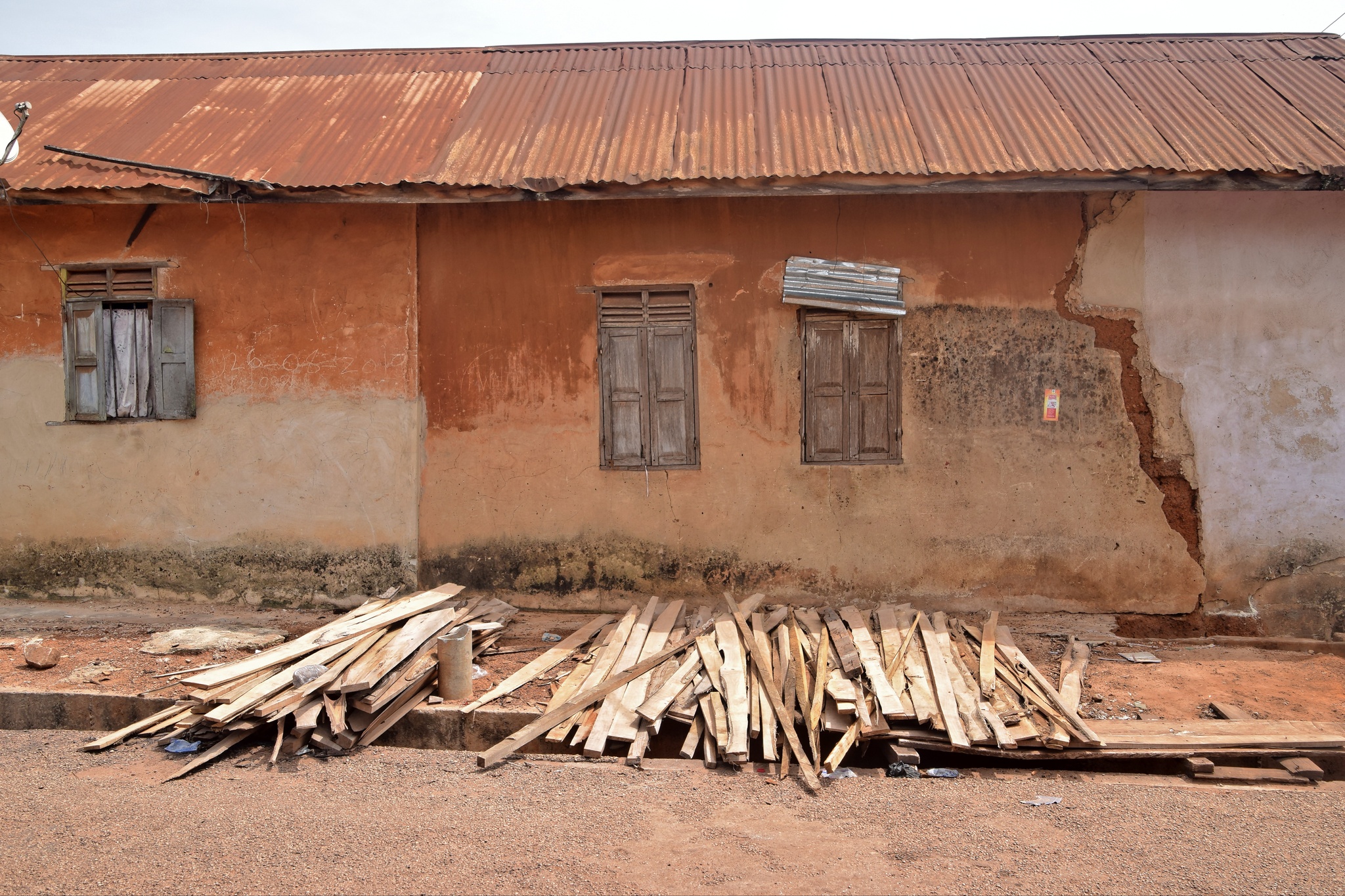
A traditional building, some 150 to 200 years old, hardly possible to renovate. Ashanti Region. © Remo Kurka
Part One: The pitch
The modern pitch to the diaspora began, in its current form, in 2019. The Year of Return marked four hundred years since the first recorded enslaved Africans arrived in Virginia. It was genuinely a remarkable piece of national imagination: an invitation to millions of people whose ancestry had been deliberately severed to come and stand in the place where it was severed. Visitor numbers rose sharply. People wept at the Door of No Return. Some of them decided not to go home again, because they had decided they already were home.
None of that is cynical, and none of it is the problem. The problem is what attached itself to it. Beyond the Return, the ten-year follow-up plan, explicitly aimed to turn visits into relocations and investment. Where a government creates a pipeline of emotionally motivated buyers with foreign currency, an industry grows to meet them. That industry now includes developers, agents, chiefs, lawyers, YouTube influencers, WhatsApp brokers, and a large number of people whose only qualification is a smartphone and a plot of land they may or may not have the right to sell.
The pitch has a consistent shape
- Ghana is stable, English-speaking and welcoming
- Property here only goes up
- Your money goes so much further
- Buy now, before prices rise
- Everybody who came is happy they did
Four of those five statements are false, seriously incomplete or unverifiable. Let us take them in order of how much they cost people.
Part Two: The land
Start with the sentence that should appear at the top of every diaspora property advertisement in Ghana, and appears at the top of almost none of them.
If you are not a Ghanaian citizen, you cannot own land freehold in Ghana. This is a constitutional restriction, not a technicality.
What non-citizens can hold is a leasehold of at most fifty years. Citizens can hold up to ninety-nine. This is not a loophole a clever lawyer can work around, and it does not change because you have a Ghanaian grandmother or a certificate from a naming ceremony. Citizenship is the line, and citizenship for the diaspora remains a slow presidential process. In November 2024, 524 members of the diaspora were granted it in one ceremony, the largest group since the Year of Return.
So when someone tells you that you are buying land in Ghana, ask precisely what you are buying, for how long, and what happens at the end. If the answer is vague, the conversation is over.
Thirteen sellers, one plot
Now the harder part. Ghana's land administration is not fully digitised. There is no complete, centralised, searchable title registry of the kind buyers from Britain, Canada or the United States assume exists everywhere. The Lands Commission has an online service, and it has improved considerably, but the underlying record is incomplete. A great deal of land is held under customary tenure by stools and families whose boundaries were historically marked by a particular tree, a stream or a rock.
The consequence is arithmetic, not conspiracy. If there is no single authoritative record of who owns a plot, the same plot can be sold more than once. And it is.
The scale is documented, not whispered
- industry research indicates that 30 to 40 per cent of urban land transactions in Ghana are affected by some form of fraud, with foreign and diaspora buyers facing the highest exposure of any group
- around 40 per cent of foreign purchasers encounter fraudulent activity
- over 70 per cent of land transactions remain informal
- only about 10 per cent of buyers conduct a proper title search before paying
- the Supreme Court has dealt with a single plot carrying thirteen different registered "sellers" at the Lands Commission
Thirteen. Read that again: thirteen people, each with paperwork, each having taken money from somebody.
The Ghana Police Service has run a dedicated Property Fraud Unit for many years. This is not a country that has recently discovered a problem. It is a country that has been institutionally aware of one for decades.
How they actually take the money
The methods are not sophisticated. They do not need to be, because the structural weakness does the work.
- The double sale. A seller takes your money, then approaches the next buyer before you have completed registration. Whoever registers first at the Lands Commission holds the valid title. Everyone else holds a receipt and a grievance. Distance makes this worse: you cannot register from Toronto in the two weeks it takes someone else to do it from Accra.
- Fabricated documents. A US-based doctor lost roughly $50,000 to fraudsters using forged land certificates. The documents looked right. That is the entire point of forging them.
- Impersonation. Someone who is not the owner, and sometimes not even related to the owner, sells you the owner's land. You discover this when you try to build on it.
- The occupied plot. You buy an uncompleted building, or land with structures, sight unseen from photographs. On arrival you find squatters, the seller's relatives, or a third party with an occupancy claim, and eviction becomes a multi-year court matter. Red flags: the seller resists physical inspection, offers viewings only on particular days, or the listing photographs are old and never show the occupied parts.
- Land guards. These are armed men who occupy or block land on someone's behalf. The Land Act 2020 (Act 1036) criminalised this with penalties of five to fifteen years in prison, which is genuine progress and worth knowing. It has not eliminated the practice.
- Currency manipulation. Prices are quoted in dollars and payments demanded in cedis at a rate of the seller's choosing, or the reverse, whichever direction the movement favours them that month.
The WhatsApp purchase
The pattern that catches diaspora buyers most often is depressingly consistent and does not require anyone to be foolish. Someone in London, Maryland or Hamburg sees photographs of a finished apartment. There is a relative, or a friend of a relative, who knows the developer. There is a deadline: the price rises next month, another buyer is interested. A deposit is sent by bank transfer, sometimes the whole amount.
None of that reflects poor judgement. It reflects the fact that every check a Ghanaian buyer would run locally is harder to run from four thousand miles away. You cannot walk the site, knock on the office door, or ask the neighbours what they know about the man selling it. And the person vouching for the deal is family, which is exactly the trust being borrowed.
Part Three: The developers
If land fraud is the old danger, the developer collapse is the growing one, and it is the reason this article exists now rather than five years ago.
The model that eats itself
Here is how a significant part of Ghana's property development sector is actually financed, as described in the industry's own analysis rather than by critics. A developer launches a project. Buyers pay deposits for units off-plan, units that do not yet exist. The developer builds stage one with the deposits from stage two's buyers. There is no substantial capital reserve and no bank facility large enough to carry the project. The incoming money is the construction budget.
This works while sales continue. It is not necessarily fraudulent. It is how a company without access to affordable credit builds anything at all, in a market where the central bank's policy rate stood at 27 per cent at the end of 2022, peaked at 30 per cent in 2023, and mortgage finance became practically unavailable.
But it has one failure mode, and it is fatal. When sales slow, construction slows. Slow construction destroys buyer confidence. Falling confidence slows sales further. The spiral closes in months, not years. And the people whose money is already inside the project, who have paid for a unit in a building that is now a concrete frame, have no way of getting it out.
What collapse looks like from the outside
The industry has a name for the end state: the ghost developer. The sequence is recognisable enough to be a warning list. Communication deteriorates. Telephone lines stop working. Customer service becomes unreachable. The office is abandoned. The site goes quiet. Social media pages fall silent. Directors become difficult to trace.
Buyers then discover that the project they put their life savings into may never be finished, and that pursuing it means years of litigation in a system that will outlast their patience and possibly their money.
One check on a single Ghanaian classifieds site found 436 uncompleted houses listed for sale in Greater Accra. Not under construction: for sale, uncompleted. Selling an unfinished building is itself a financing method, because it raises capital without incurring interest. That tells you how normal this has become.
Two cases you can look up
La Beach Towers is the one to understand, because it failed for reasons that had nothing to do with criminality and everything to do with the model. The project stalled between 2009 and 2012 as construction costs rose sharply. And here is the detail that should be printed on every off-plan contract in the country: many of the apartments did not actually have the ocean views buyers had been promised. To cover the funding gap, prices were raised, which drove away the remaining buyers whose deposits were meant to close it. One of the co-owners, MP J.B. Danquah-Adu, died in 2016, and investor priorities shifted. With nobody maintaining the site, sea air went to work on exposed steel and concrete. A development marketed as luxury living became a corroding safety concern on the Accra shoreline, visible to anyone driving past.
Saglemi is the public-sector equivalent, and the numbers are extraordinary: over $159 million allegedly misappropriated. Former works and housing minister Francis Asenso-Boakye has estimated that completing it could now require at least $140 million more. The Africa Report has called it Ghana's $200m ghost estate. Successive governments have promised to finish it. It sits there. Asenso-Boakye's own comment on the wider pattern is worth repeating for its bluntness: new projects should not be started while others sit abandoned and rotting.
Failure is not always fraud, and the difference matters
This needs saying, because the honest version is more useful than the angry one. In 2022 the cedi lost more than half its value against the dollar at its worst point, and ended the year about 30 per cent down even after the December recovery. Inflation hit 54.1 per cent. A developer whose project collapsed in that year is not necessarily a criminal. That is a business destroyed by a macroeconomic event, and there were many of them.
A developer who took deposits knowing the project would never be built is something else entirely. From the buyer's side, unfortunately, the outcome is identical: your money is gone either way. That is why the defence has to be structural, with milestone payments, verified companies and physical inspection, rather than a judgement about whether the person across the table seems honest. They usually do.
Part Four: The utilities nobody mentions
This is the part that surprises people most, because it is not in any brochure, and it affects daily life more than anything else on this page. You can buy the house, complete the paperwork, register the title and move in, and still find that the water does not run and the power goes off every week.
The water
Ghana Water Limited publishes shutdown notices. They make instructive reading if you compare them with where the diaspora is being told to buy. The industry's own relocation guides name East Legon as the largest diaspora returnee community in Ghana. It is the premier address, the one in the photographs, the one the agents show first.
In 2026 alone, a partial record for East Legon and its neighbours
- 19 January: a major burst on a 42-inch transmission pipeline disrupted supply across eastern Accra, including Tema, Ashaiman, Spintex, Nungua, Teshie and parts of East Legon
- 9 July: a 24-hour shutdown of the Dodowa Booster Station affected East Legon, Adjiringanor, Ashaley Botwe, Madina, Adenta, Oyarifa, Frafraha, Agbogba, Haatso, Atomic, Ashongman, Dome and Dodowa
- 6–8 August: a three-day shutdown of the Kpong Water Treatment Plant, after a routine inspection found over 300 metres of weakened pipeline needing urgent replacement to prevent a major failure
That last one deserves attention. Three hundred metres of pipe on a critical transmission main deteriorating to the point of urgent intervention is not a maintenance story. It is a story about ageing infrastructure.
And now the part that should be in every diaspora property article and is in none of them. Ghanaian reporting on the July shutdown noted something the official notice did not: many of the communities on that list already receive water for only a few hours, or not at all, and depend heavily on tanker drivers who charge high prices. The Herald headlined its coverage a "windfall for the water tanker cartel".
Read that against the sales pitch. The premium neighbourhood sold to returning diaspora as the good address is substantially supplied by private water tankers, and every official shutdown is a payday for whoever controls them. Nobody selling you a house in East Legon is going to mention the tanker bill. Ask what it costs. Ask how often. Ask whether the house has a poly tank and a borehole, and if it has a borehole, ask what happens in the dry season.
The power
Dumsor, Akan for "off and on", is not history. It is current.
- 20 April 2026: an ECG manager publicly apologised for power cuts, describing them as a weekly occurrence
- 29 July 2026: outages from around 3am across what appeared to be much of the country, including Oyarifa, Adenta, Madina, Legon, Nungua, Tesano, Adabraka, Weija, Dansoman, Kasoa, Kumasi, Aburi and parts of the Central and Northern regions, with reports from Tumu, Techiman, Kintampo and Kpetoe. Neither ECG nor GRIDCo confirmed a cause, and no restoration schedule was published.
- 16 August 2026: a fifteen-hour outage across parts of Accra after a fuel tanker explosion during welding damaged a transmission tower on the Tema–Achimota 161kV line
The structural position behind those events: ECG has been reported to owe roughly $1.2 billion to private power producers. About 70 per cent of Ghana's dependable generating capacity is thermal and depends on gas supply, including imports through the West African Gas Pipeline, which has repeatedly been interrupted. ECG has proposed a 225 per cent increase in its Distribution Service Charge.
And the two failures compound. Ghana Water has directly blamed water supply disruptions on nationwide power outages. No electricity means no pumping, which means no water, even where the pipes are sound. We break down the household costs in The Hidden Costs of Living in Ghana.
What this means in practice
A house in Accra that works reliably needs a generator or a solar system with battery storage, a poly tank, and often a borehole and pump. These are not luxuries here. They are the difference between a house that works and a house that does not. Nobody includes them in the advertised price. Budget for them, or budget for the tanker.
Part Five: The numbers behind "property only goes up"
The investment case is usually made with a wave of the hand at the last decade. Here is the part of the decade the wave skips. 2022 was the worst economic year in Ghana in a generation:
- inflation reached 54.1 per cent in December 2022, the highest in more than twenty years
- the Bank of Ghana policy rate was raised to 27 per cent by the end of 2022, and to 30 per cent in 2023
- the cedi lost more than half its value at the worst point of 2022, and ended the year about 30 per cent down against the dollar
- public debt rose above 90 per cent of GDP, triggering default, domestic and external restructuring, and an IMF programme
The recovery since then has been real: growth of around 6 per cent in 2025, inflation down into single digits by early 2026, the cedi strengthened on gold and oil, and a current account surplus. That should be acknowledged, and the people who managed it deserve the credit.
But look at what happened to property returns underneath all that:
- capital appreciation in prime Accra residential property has slowed to 4–7 per cent a year in dollar terms
- rental yields have compressed as supply outpaced demand in the mid-to-premium segment
- luxury villas are soft
- Ghanaian investors with capital are being openly advised to look at off-plan property in Dubai instead
Four to seven per cent in dollars, in a market with the transaction risk described in Part Two and the infrastructure costs described in Part Four, is not the wealth engine being advertised. It is a modest return with substantial downside. The cedi has lost roughly half its value against the dollar since the start of 2022, from about GH¢6 to more than GH¢11, and that matters enormously if your income is in cedis and your expectations were set in dollars.
Part Six: The rent trap
If you are renting rather than buying, and for a first year in Ghana you almost certainly should be, there is one number to know. Landlords in Ghana routinely demand one to two years of rent in advance, in cash, before you have keys. The Rent Act on paper limits advance rent to six months. In practice the rule is widely ignored.
This is standard practice. It applies to Ghanaians and returnees alike, and it pushes lower-income Accra residents into debt every year. For a returnee it means the first housing payment is not a deposit and a month in advance. It is potentially twenty-four months, in a currency you are converting into, for a property you have seen once. Budget accordingly, and never pay it before a lawyer has read the tenancy agreement. More in our real checklist for moving to Ghana.
Part Seven: Who is actually profiting
Follow the money and the picture becomes clearer.
- Developers raise construction capital from buyers rather than banks, transferring the entire financing risk to people who have no way to monitor or control the project.
- Agents and brokers are paid commission on completed sales, not completed buildings. Their incentive ends at the transfer.
- Some chiefs and family heads sell the same customary land repeatedly, because customary tenure is poorly recorded and the penalty for doing so is slow and uncertain.
- Water tanker operators benefit directly from a failing municipal supply in the wealthiest neighbourhoods. A working pipe network would end their business.
- Influencers monetise the dream. NPR's reporting on the Pan-African Village settlement at Asebu, where a paramount chief set aside 5,000 acres and offered free plots to diaspora settlers for an administrative fee, documents how prominent YouTube figures promoted it as a once-in-a-lifetime opportunity. It names one who personally encouraged a Jamaican-Canadian retiree to make the journey, and then documents the tensions over ownership and privileged access that followed. New Lines Magazine has separately covered the land disputes facing African Americans there. We took the influencer script apart in The Biggest Lies Influencers Tell About Ghana.
None of these actors is necessarily lying, and several are certainly not. But every one of them is paid at the point of your decision, not at the point of your outcome. That is the structural fact to hold on to when someone tells you to move quickly.
Part Eight: The cost to Ghanaians
This piece is written for the diaspora, but it would be dishonest to leave this out. Al Jazeera interviewed a pharmacist who has lived on Oxford Street in Osu his entire life. His take-home pay is around $300 a month, and taking his family to a restaurant on his own street now costs him around $100. In his words, the restaurants price for foreign pockets, the shops target expatriates, and people like him are being driven out of the neighbourhood they grew up in.
The Harvard Kennedy School Review put the institutional version plainly: in pursuing tourism and investment, the government overlooked some of the needs of its own people in favour of attracting foreign capital. Remember, too, that Ghana's national minimum wage in 2026 is GH₵21.77 a day, less than two US dollars.
If you are coming, come knowing that. A returnee who arrives understanding that their dollars are reshaping a neighbourhood, and behaves accordingly, is a very different neighbour from one who does not.
Part Nine: What to actually do
None of the above is a reason not to come. It is a reason to arrive with your eyes open and your money slow.
Before you send a single cedi
- Rent first, for at least a year. Live in the area before you buy in it. Find out what the water and power are actually like on your street, in both seasons. There is no substitute for this, and no photograph replaces it.
- Hire your own lawyer. Not the seller's, not the developer's recommendation, and not a family friend who does a bit of property work. You need a property lawyer licensed by the Ghana Bar Association, whom you found, who is paid by you and who acts for nobody else in the transaction. Legal fees and registration together run at around 3 to 5 per cent of the property value. Treat it as insurance.
- Run an official Lands Commission search. Not a photocopy someone shows you, but an official search, ordered before any money moves, that checks for caveats and duplicate registrations. The government fee is modest, a few hundred cedis. It is the cheapest thing you will ever buy.
- Verify the company, not the project. Confirm that the developer is registered with the Office of the Registrar of Companies. Check GREDA membership and REAC registration. Visit a finished project, a building with people living in it, or send someone you trust to stand inside one. A serious developer will show you registration documents, past handovers and a physical office. Anyone who exists only on Facebook and cannot show a track record is not a developer.
- Inspect physically. Either go yourself or send an independent inspector who is not the seller's representative. You want a live video walkthrough plus a written report from your own person, never the agent's video.
When you pay
- Tie payments to verified milestones, never to dates. "On completion of the first-floor slab, verified by my inspector", not "on 30 June".
- Pay only into registered company bank accounts. Never personal accounts, never cash, never mobile money for a property transaction. Keep every receipt.
- Understand that formal escrow is not widespread in Ghana. The realistic substitute is a milestone-linked bank transfer against a lawyer-reviewed contract, with documentation at every step.
- Register immediately. The moment the agreement is signed, begin registration at the Lands Commission. The gap between payment and registration is the window in which double sales happen.
After you buy
- Fence the plot and put a caretaker on it who is visible to the community. Unattended land invites encroachment and squatters.
- If land guards appear, do not engage. Report them immediately to the Police Property Fraud Unit and your lawyer.
- If something goes wrong, stop all further payments and gather every record: transfers, messages, contracts, receipts. Report to the police and to the Economic and Organised Crime Office, which handles property and financial fraud, then brief your lawyer fast. At that stage, speed matters more than anything else.
The honest verdict
Ghana is not a scam. It is a real country with a real economy, a genuine recovery under way, a rule of law that works imperfectly but works, and a land administration system that is slowly being digitised.
It is also a country where a third of urban land transactions involve fraud, where the Supreme Court has seen one plot with thirteen sellers, where developers finance construction with your deposit rather than their capital, where the best neighbourhood in Accra buys its water from tankers, and where the power goes off every week with no explanation from anyone.
Both of those paragraphs are true at once. The people selling you the first one and hiding the second are not your friends, however warmly they greet you at the airport.
Come. Many people should. But come the way you would move to any country where you do not yet know how things work: renting, slowly, with your own lawyer, paying against milestones, and asking every question twice.
The ancestors you are coming back for were taken from here without consent or paperwork. You do not owe anyone a repeat of that in reverse, least of all a man with a signboard and a tin of paint.
Get to know the neighbourhoods before you buy. A guided day out shows you more of Accra and its surroundings than any agent's video. These tours are run by local operators. Entrance fees are already included in the tour price. Tips are not included, but they are always welcome.
Written for Ghana Without Filters. We have no property to sell you, no developer partnership, and no affiliate arrangement with anyone named or unnamed above. If you have been through this, or are going through it now, we would like to hear from you. This page will be updated as more is documented.
More from Ghana Without Filters
- How to Prepare for Moving to Ghana: A Real Checklist
- The Hidden Costs of Living in Ghana
- The Biggest Mistakes Returnees Make When Moving to Ghana
- Why Many Returnees Fail, and How to Avoid It
- The Biggest Lies Influencers Tell About Ghana
- The Emotional Reality of Returning Home
- Ghana Government: Ghana's Digital Identity Is Being Hijacked – Where Are the Authorities?
- Who Sold Whom? Ghana's Slave History Without the Marketing
- Why the African Diaspora Should Visit Ghana in 2027: Ghana at 70
- Ghana Road Deaths: Eleven Billion Cedis Idle
- A Few Words Go a Long Way: The Languages You Will Hear in Ghana
- The Sad Reality of VisitGhana.com
- Ministry of Tourism: Thank You for Bringing Ghana Travel Back Online
- The Ghana Guide That Sends You to Singapore: How to Spot an AI-Written Travel Book
- Why You Don't Need Another Ghana Travel Book
- Your Next Trip to Ghana: €53.90 for 13 Days? Seriously?
On Ghana-Net.com and GhanaWeb-News.com
- Where Half of Accra's Water Actually Goes - 22th Aug 2026
- Ghana Without Filters: A Realistic Guide for the Diaspora
- Checklist for Identifying Ghana-Based Scams
- The Most Dangerous Online Scams in Ghana (2026)
- Accra and Tema and Ashaiman
- Regions and Capitals of Ghana
- Ghana Live Radio
- All African Radio Stations
Sources: Figures are drawn from Ghanaian and international reporting, published research and official notices, including Ghana Water Limited shutdown notices, ECG statements, The Herald, NPR, New Lines Magazine, Al Jazeera, the Harvard Kennedy School Review and The Africa Report. Bank of Ghana data for 2022: inflation of 54.1%, policy rate of 27% at year end, and cedi depreciation of about 30% for the year, as reported by Ghana Business News. Diaspora citizenship ceremony of 19 November 2024: Ghana News Agency. Conditions change, so verify anything you intend to act on.
Text and photo © Remo Kurka, Ghana-Net.com · Updated and fact-checked: 5 November 2026